
Tooth bonding or dental bonding is an excellent technique for small defects in teeth—chips, spots, gaps between the teeth. It isn’t so well suited for smile makeovers, though it is sometimes used for that.
| Here is a photo of a dental bonding case that illustrates how well this technique works in fixing a chipped tooth. This is a case that I did in my office. The tooth is badly chipped. I roughened the surface, etched the tooth, and applied a bonding agent. Then I applied composite restorative material to fill in the missing parts of the tooth. Notice how the dental bonding blends with the tooth so that it is imperceptible where the bonding ends and where the tooth begins. |
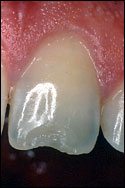 This tooth is discolored and chipped |
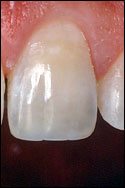 Here is the repair, done with dental bonding. |
Notice also that the tooth is not a uniform color. It has a brownish tinge near the gumline and gets gradually lighter the closer you get to the biting edge. There are subtle areas in the middle of the tooth where there is a frosty white color. Then right near the biting edge it gets very translucent, and right at the biting edge there is a thin whiter area that cosmetic dentists call the halo. To duplicate the coloring of this tooth, I had to use several different composites of varying colors and translucencies. Then notice the pattern of light reflection. This pattern is caused by natural undulations in the tooth surface, which also have to be duplicated, and the composite has to be brought to a high gloss so that it will create these reflections. Finally, notice the two slight dimples in the biting edge. All front teeth have these dimples when they first erupt, and then the edge will tend to wear to become a straight line as the patient gets older. A cosmetic dentist will thus vary this characteristic depending on the age of the patient and the condition of the other front teeth.
Doing work like this requires a true artist. Dentists tend to have an engineering tendency—they are good at fixing things. The vast majority of them do not have the kind of artistic inclinations for doing tooth bonding work like this. And it’s not just the artistic sensitivity in being able to create the bonding, but it shows in the commitment of the dentist to pursue the training needed. Furthermore, the dentist has to stock the required materials, with the variety of shades, translucencies, tints, strength, and polishability. For example, the strongest composite materials often will not produce a high suface gloss, so an expert cosmetic dentist will build the inside of the repair with stronger materials and then put a weaker microfill on the surface because it will take a high polish. So we strongly recommend that if you need tooth bonding work done and if the appearance of the work is important to you, that you seek out a true cosmetic dentist. See our cosmetic dentist referral page for more information.
Here are photos of another tooth bonding case that I did, restoring a chipped tooth. Notice again the subtle gradations of color, the gloss, and the mimicking of the translucency of the natural tooth in this work. Also notice that the tooth isn’t a perfect mirror image of the other front tooth, which is what we tend to see in nature.
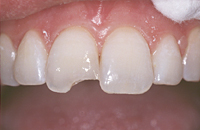
This tooth has a large chip
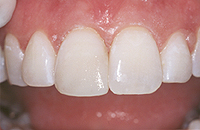
Tooth bonding restores the natural appearance of the tooth
Dental bonding can correct a tooth gap, can cover spots, chips, and discolorations, can repair fractures, and can re-shape teeth.
This is generally used for smaller defects in one or two teeth. When a cosmetic dentist does a complete smile makeover, generally he or she will use an “indirect” technique, such as porcelain veneers, and the veneers will be shaped and baked in a laboratory according to the smile design prescription of the cosmetic dentist, and then applied to the teeth.
Tooth bonding is a “direct” technique in that it is done by the dentist directly on the tooth. This, of course, requires artistic ability on the part of the cosmetic dentist, since the work is done freehand with no outside help. Colors must be matched and blended, the tooth must be sculpted, finished, and polished to a beautiful result. We believe that patients should seek out specially trained expert cosmetic dentists to have this done. To find a dentist who is expert in these techniques, please see our referral page.
While dental bonding works very well for these small defects in the teeth—chips, spots, and gaps between teeth—it doesn’t work well for large smile makeovers. Porcelain is the material usually chosen by cosmetic dentists for smile makeovers. There are two reasons for this. First, when many teeth are being treated, the work becomes very time-consuming. Doing a smile makeover with dental bonding requires chair time, which is expensive. It ties up the entire dental office and requires the presence of a dental assistant and other staff. This amount of work can be done much more efficiently and cost-effectively by a dental laboratory with a master ceramist.
Second, the composite used for dental bonding isn’t nearly as durable or stain-resistant as porcelain. It seems wasteful to spend all those hours on a beautiful smile makeover only to have it begin to show signs of wear in a year or two. When dental bonding is used on small repairs, it seems to retain its luster better.
By Dr. David Hall
Related information:
- For information about the tooth bonding technique, please see our page, How cosmetic tooth bonding is done.
- Click here to see photographs of tooth bonding work.
- Click here to learn about the costs of tooth bonding.
- See how this can be used to repair a severely broken front tooth. You’ll be amazed at one can be done in one appointment by an expert, artistic cosmetic dentist. Don’t ask a regular family dentist to do this kind of repair, except temporarily.
- Learn about composite veneers.
- Dental bonding can be used when a smile makeover needs to be done quickly, such as for a wedding smile makeover.
- Can you get dental insurance to pay for this procedure?
- We have a page about whitening toothpaste that leads to other information helpful in taking care of cosmetic dental work.
- Read about invisible braces.
- Read Dr. Hall’s blog posts about tooth bonding, where he answers questions from visitors.
Click here if you have a question for Dr. Hall and would like an answer by email.