
While in strict dental terminology the word “dentures” means any tooth replacement, it is usually used to refer to removable appliances that replace missing teeth. There are two kinds of dentures—full and partial.
Complete removable dentures should be a treatment of last resort. It is always preferable to have your own natural teeth. But in some cases, patients get so frustrated and discouraged with maintaining their teeth that they give up on them, get them extracted, and have a complete set of false teeth made. In some cases, particularly with advanced gum disease, there is no way to save the teeth.
Some patients view this as a matter of economics—they feel they can’t afford to maintain their teeth any more. However, removing the teeth and placing dentures isn’t cheap either. I once calculated the cost of a complete set of false teeth, upper and lower, including the cost of the tooth extraction surgery and the additional surgery required to prepare the patient’s mouth for the denture. Instead of getting the dentures, if the patient were to put all that money into a mutual fund that earned a modest 8% annual return, they could have routine checkups and cleanings and a filling or two every year on the dividends. At the end of ten years they would still have their own teeth and also have the full original value of the mutual fund.
However, in cases where the teeth need extensive work, complete dentures will likely be more economical. And if finances are limited, they may be the only option. But it is not ideal treatment.
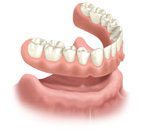
It is a fallacy to think that complete dentures mean the end to troubles with your teeth. Lower dentures are particularly problematic. Surveys show that about three-fourths of the people with lower dentures are unhappy with them. About half of those with upper dentures are unhappy with them. Upper dentures are held in place with suction and tend to be more stable. Lower dentures are held in place by gravity. They can be dislodged by the tongue or by the cheeks, so they tend to move around. But the unhappy patients are usually embarrassed about having dentures, so you don’t hear their complaints.
Bottom line—try to save your own natural teeth if you can. If you lose them, look into dental implants and avoid dentures.
Other useful information:
- “Cosmetic dentures” is a term used to refer to false teeth where extra attention is paid to their appearance. When they are done by an expert cosmetic dentist, it can make a big difference in their appearance.
- When all the teeth are extracted, the jawbone will shrink. When a patient is young, say in his or her thirties, and has all the teeth extracted at that young age, by the time he or she reaches the age of fifty or sixty the jawbone will be so thin that the patient may end up being a dental cripple who can’t wear a denture comfortably. This condition is called facial collapse.
- Soft dentures can be an answer for these people with a shrunken jawbone. The soft liner makes them more comfortable and a little more snug. Read about the pros and cons here.
- When your dentures need repair, it’s important to see a dentist right away. Home repairs can make it more difficult and more expensive, or even impossible for a dentist to make the permanent repair. These repair procedures are generally not very expensive – much less expensive than a complete new denture.
- Oral yeast infection can occur under your plates if you never take them out.
- Immediate dentures are placed in your mouth on the same day your teeth are extracted, so that you don’t need to go for weeks with no teeth. They work very well, and are generally recommended for all patients.
Read Dr. David Hall‘s blog posts about dentures, where he answers questions from visitors.
Click here to ask Dr. Hall a question.