
One way to replace a tooth is the Maryland bridge. It is popularly believed that this bridge technique was invented by dentists at the University of Maryland. However, we have it on good authority that this bridge was actually invented by a dentist in Atlanta, Dr. Stewart R Halbauer, and was discovered and popularized by the University of Maryland. Click here to read the story of the invention of the Maryland bridge, as told by Dr. Halbauer’s son. The dentists at the University of Maryland who made this bridge popular were Dr. Gus Livaditis and Dr. Van Thompson. Interestingly, if you carefully read the website of Dr. Livaditis, you will note that he never claims to be the inventor of the Maryland bridge and only states that he and Dr. Thompson were co-developers of this bridge.
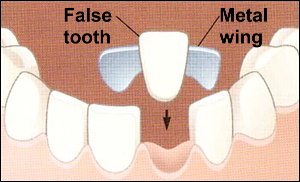
There are two main aesthetic problems with a Maryland bridge, and both of them have to do with the use of the metal. The first problem is that natural teeth are translucent. Therefore, the metal backing that is bonded onto the back side of the front teeth will cause those teeth to darken slightly, and they will no longer match the color of the other front teeth. If the dentist doesn’t take this darkening into account (and very few dentists do), the false tooth that is replaced will also be slightly lighter in shade than these darkened teeth on either side.
The second problem, which is less significant but is still an issue, is that the false tooth is a porcelain fused to metal tooth, and it lacks the natural translucency and vitality of your other teeth. The most aesthetic false teeth are those made entirely with tooth-colored materials.
We have some pictures of a Maryland bridge posted where an expert cosmetic dentist has replaced it with a more aesthetic false tooth. We also have several blog posts about the Maryland bridge.
With the development of new, tough, ceramics, there is a more aesthetic version of this bridge that is made out of zirconia. Click here to read about the zirconia Maryland bridge.
An alternative is an Encore bridge, which is made entirely of tooth-colored materials, and so it is also more aesthetic.
You may also be interested to read about the ovate pontic technique, which makes it appear that the false tooth is growing out of the gum.
This content was written by Dr. David Hall. Click here to ask Dr. Hall a question.