
Question:
My dentist wants to put a porcelain onlay on my tooth. What are porcelain onlays?
Answer:
A porcelain onlay is similar to a dental crown in that it is designed to restore a tooth that is broken down so much that a filling is not enough to fix it. If too much of the tooth is missing, the tooth could fracture. A porcelain onlay covers most or all of the chewing surface of the tooth and strengthens it so that it won’t fracture.
How porcelain onlays differ from crowns
A crown covers the entire chewing surface of the tooth and wraps around the entire tooth, all the way to the gum line. The porcelain onlay is more conservative. It covers only those parts of the tooth that are weak and it will not go down to the gumline.
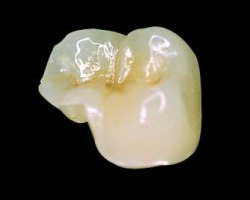
Here is a picture of a porcelain onlay. It’s usually about two millimeters thick, and it covers at least one cusp of the tooth. This example is made to fit a molar tooth, and it covers three of the four cusps of the tooth.
Advantages of porcelain onlays
One advantage of porcelain onlays are that they preserve more of the natural tooth structure. There is a feeling many dentists have that if tooth structure is healthy, it is best to leave it alone if possible.
A second advantage is that, since they don’t go down to the gumline, there is no chance of them irritating the gum. Crowns can cause gum irritation and in some cases can even contribute to gum disease. Also, since they don’t go down to the gumline, it is easier to keep the margin (that line where the porcelain onlay or crown ends and the tooth begins) clean. The margin is out in the open where you can easily brush it. The margin of a crown is the place that is most vulnerable to recurrent decay. Thus, porcelain onlays are less likely to get new tooth decay.
Third, porcelain onlays, being made entirely of porcelain (or another ceramic), are very esthetic. They look extremely natural.
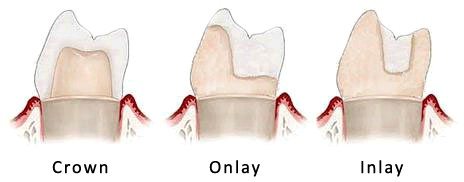
To clarify the difference between a porcelain onlay, an inlay, and a crown, here is a diagram. In this case, the porcelain onlay covers both cusps of the tooth, just like the crown does. But the crown will go all the way down to the gumline, where an onlay will not. And an inlay does not cover any cusps but sits entirely inside the tooth.
Disadvantages
Porcelain onlays require a great deal of expertise to place correctly. They require extensive training in cosmetic dentistry and in occlusion. We recommend that you only have an expert cosmetic dentist do one. (For referral to an expert cosmetic dentist, see our referral page.)
Secondly, porcelain onlays made entirely of porcelain are not as strong as gold crowns or porcelain-fused-to-metal crowns, so they can be more susceptible to breaking, although newer ceramics are extremely strong. The chances of breaking are minimized if you are having this done by an expert cosmetic dentist.
This second disadvantage is greatly minimized if a dentist uses one of the newer high-strength ceramics such as zirconia or lithium disilicate. Onlays made out of these materials are usually milled by a computer and may be prepared and placed in one appointment.
For general information on crowns and a comparison of the various choices of crowns and onlays, see our page explaining porcelain crowns compared with other types of crowns.
Click here to return to frequent questions about cosmetic dentistry.
This content was written by Dr. David Hall.
Click here to ask Dr. Hall a question.